
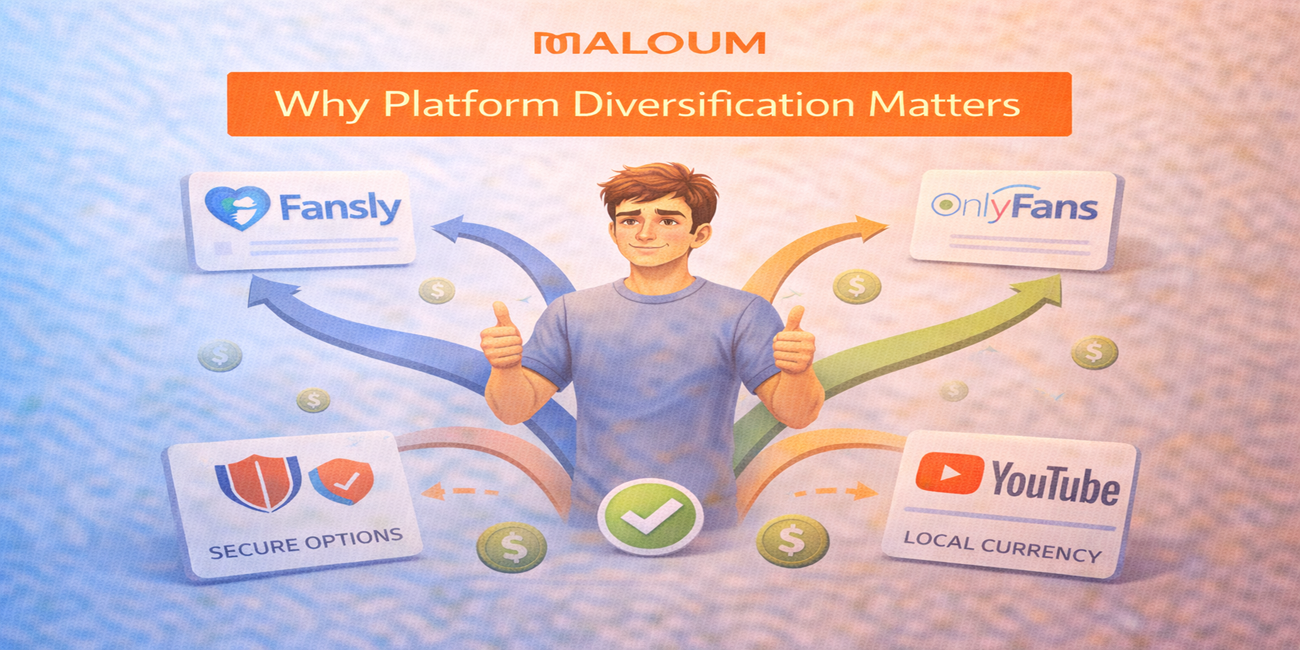
Why Platform Diversification Matters
Why platform diversification matters is simple: it reduces the risk of your income collapsing from one platform issue. When all revenue streams flow through a single account, you are exposed to platform algorithm changes, payment disruptions, discovery volatility, and account restrictions. Most creators still depend on a single income source, which is risky due to platform volatility. Diversifying across platforms, offers, and traffic sources makes creator income more stable without requiring you to abandon what already works.
For content creators, this is not about chasing trends. It is about building a business that can handle change and achieve long term success. Understanding your target audience is crucial when selecting which platforms to diversify into, ensuring your content reaches the right people. Diversifying creator revenue streams is essential for financial stability in 2026.
Single-Platform Dependency Is a Revenue Risk, Not a Mindset Problem
Creators often blame themselves when income feels unstable. But instability is often structural. Many creators depend heavily on one income channel, such as advertising, sponsorships, or platform-based payouts, which poses significant risks. If you are relying solely on one platform, and that platform controls:
- your audience access
- your payment and payout environment
- your discovery and visibility surfaces
- your moderation and policy rules
…then your revenue is concentrated. Concentration creates fragility. Even if you are doing everything right with your content strategy, one disruption can create a real income shock:
- a temporary payout delay
- a sudden enforcement change
- a payment processor issue
- a visibility drop due to a platform algorithm update
- an account review
Most creators manage an average of 4 platforms, but only 1.9 actually generate revenue, showing that effective platform diversification is essential. Platform diversification does not eliminate risk, but it prevents one risk from controlling your entire month.
Diversification Is Not More Work, It Is Better Structure
The biggest reason creators avoid trying to diversify income is the fear of doubling their workload. That only happens when diversification is unstructured.
A strategy that supports stability usually looks like:
- one primary platform as your core
- one additional platform layer with a sustainable cadence
- a clear division of what goes where, utilizing different content styles so you are not just reposting the same visual content
- a simple offer strategy that does not confuse fans
It is less "post everywhere" and more "add redundancy." If your primary platform is working, you do not need to blow it up. You need a second path for revenue, discovery, and payments so you can stay ahead in a crowded market.
The Revenue Mechanics Behind Why Diversification Works
Diversification works for the same reason it works in any business: it reduces single points of failure. For popular creators, the most common failure points are:
Payment Risk
Checkout systems can fail in ways creators cannot control: declines, restrictions, friction, failed renewals, or temporary payout delays. If you rely on one payment environment, your entire income inherits that risk.
Policy and Enforcement Risk
Platforms update policies and enforcement intensity over time. You do not need to be doing anything wrong to be affected. Even small changes can force creators to adjust existing content, pricing, or messaging quickly. Maintaining control requires backup options.
Discovery and Traffic Risk
Many creators depend on external social media platforms for traffic. If reach drops, signups drop. If you also rely on a platform with limited internal discovery, your growth engine is tied to algorithm changes you do not control.
Churn and Baseline Instability
Even strong creators lose subscribers. If you only monetize through subscription models, churn makes income feel like a treadmill. Diversification helps by adding multiple income streams and additional acquisition pathways.
When income has more than one pathway, it becomes harder to break.
Diversification Starts With Monetization Layers and Revenue Streams, Not Just More Platforms
Before you add a second platform, diversify how you earn. A subscription-only model is fragile. A stable creator stack usually includes multiple revenue streams:
- subscriptions for baseline recurring income
- predictable PPV drops for upside
- bundles and digital products as evergreen offers
- tips tied to interaction moments
- occasional premium drops for top spenders
- brand partnerships, brand deals, and branded content
This matters because it increases lifetime value. Higher lifetime value reduces how much churn hurts. It also opens doors to passive income through online courses or ad revenue.
What Platform Diversification Looks Like Across OnlyFans, Fansly, and MYM
Diversification is not a judgment on any one platform. It is a response to how creator businesses work.
- OnlyFans: Many creators rely heavily on external funnels. When traffic dips, revenue dips. Diversification helps because it reduces platform dependency.
- Fansly: Often used as a second layer because creators want redundancy. It still requires strong conversion and retention, but it can reduce single platform risk when added calmly.
- MYM: Can function as another revenue layer depending on audience behavior. Marketplace traffic can add opportunity, but it is comparison-driven, so digital storefronts must be clear.
Each platform offers unique features and opportunities, so evaluating each platform's strengths allows you to tailor your content and maximize its impact.
No platform removes risk by default. Your structure does.
The Calm Diversification Plan That Professional Creators Use
Creators who build stable income do not diversify in panic. They do it in phases.
Phase 1: Stabilize Your Core
- improve onboarding so new subscribers do not churn immediately
- set a predictable cadence you can sustain with your social media posts
- build one upsell rhythm (PPV or bundles) to increase engagement
Phase 2: Diversify Discovery
- add one secondary traffic source to reach new audiences
- use collaborations to generate warm traffic
- improve your marketplace storefront so cold traffic can convert
Phase 3: Add an Additional Monetization Layer
- choose one additional platform to reach a broader audience
- post at a sustainable cadence using various formats
- keep offers clear and consistent
- do not duplicate everything everywhere; leverage a platform's strengths
The goal is redundancy without chaos. If you try to diversify by doing everything at once, you usually end up with weaker audience engagement on your core platform.
Where MALOUM Fits Into Platform Diversification
Platform diversification is ultimately about reducing dependency on one platform's discovery system and checkout environment. This is where MALOUM fits as creator monetization infrastructure and an additional monetization layer, not as a replacement platform.
First, diversification becomes more effective when creators have discovery optionality. Many creators rely on external funnels, which makes income volatile. MALOUM is positioned around marketplace discoverability, creating a second pathway where fans can find creators. Internal visibility is not guaranteed, but it provides another discovery engine that can contribute to stability when external reach dips.
Second, diversification is also a payment risk strategy. If all revenue flows through one checkout system, card declines or renewal failures can quietly cap earnings. MALOUM emphasizes flexible payment infrastructure and reduced checkout friction. More payment accessibility means fewer lost transactions across your monetization strategies. This allows you to track performance and track engagement accurately.
Third, creators benefit most when diversification is additive. By treating MALOUM as an additional monetization layer, you add redundancy across discovery and payments. Allowing creators to operate multiple channels safely is the point of platform diversification.
Measuring Success in Platform Diversification
Measuring the success of platform diversification is essential for creators who want to build sustainable, long term growth and avoid the pitfalls of relying solely on a single platform. With so many options for content creation and monetization, understanding what works—and why—can make the difference between steady revenue streams and missed opportunities.
Start by tracking key performance indicators (KPIs) across all your platforms. Audience engagement is a top priority: monitor likes, comments, shares, and other interactions on your social media posts to see which content formats and topics drive the most engagement. Pay close attention to audience growth as well—track new followers, subscribers, and the reach of your content to ensure your efforts are attracting a broader audience and not just recycling the same audience across different platforms.
Revenue streams are another critical metric. Break down your income by source: ad revenue, brand partnerships, affiliate sales, and direct sales of digital products. This helps you identify which platforms and monetization strategies are delivering the most value, and where you might want to double down or pivot your content strategy.
To get a clear picture, use analytics tools like Google Analytics, built-in social media insights, and platform-specific dashboards. These tools provide detailed performance data on audience demographics, content reach, impressions, and click-through rates. By comparing how your visual content, live streams, and other content formats perform on different platforms, you can refine your approach for better performance and increased engagement.
It’s also important to stay alert to platform algorithm changes. Shifts in a platform algorithm can impact the visibility and engagement of your content overnight. By regularly reviewing your analytics, you can spot trends early and adjust your posting schedule, content style, or even which platforms you prioritize to stay ahead in a crowded market.
AI tools can further streamline this process, helping you analyze large sets of performance data, identify new opportunities, and optimize your content for each platform’s strengths. Whether you’re experimenting with new content formats or testing different posting cadences, AI can help you track what’s working and automate routine tasks, freeing up more time for creative work.
Ultimately, measuring the success of your platform diversification is about more than just numbers—it’s about making informed decisions that drive recurring income and long term growth. By tracking the right metrics, analyzing performance data, and staying adaptable to algorithm changes, creators can increase engagement, diversify income, and build a resilient business that thrives across multiple platforms.
Practical Creator Scenarios
A creator's main social channel loses reach for two weeks. New subscribers drop sharply. Because they have a second discovery pathway and a second monetization layer, the month does not collapse. They still earn while social media recovers.
A video creators group experiences inconsistent renewals despite strong engagement. Payment friction is likely involved. By diversifying revenue pathways and strengthening payment accessibility, baseline income becomes steadier.
A creator gets hit with a temporary account limitation on their primary platform. Instead of losing the entire month, they have an additional layer already active and earning. The disruption is painful, but not catastrophic, preserving their long term growth and creative freedom.
FAQs
What does platform diversification mean for creators?
Platform diversification means building income across more than one platform so your revenue is not controlled by a single account. It includes adding a second subscription platform, but also diversifying traffic sources and building multiple revenue layers like PPV, bundles, and the ability to sell digital products.
When should creators start diversifying platforms?
Earlier than most do, but not before your core is stable. A good time to diversify is when you have a clear offer, a sustainable posting cadence, and basic onboarding in place. If you diversify too early, you might spread yourself thin. If you diversify too late, you will do it in panic after a disruption.
Does platform diversification reduce income because fans get split?
It can if diversification is unstructured, but it often increases stability rather than splitting revenue. Many creators use a second platform layer to capture additional revenue opportunities, tap into different demographics, and reduce risk, not to move all fans. The goal is to make your business less fragile by having more than one earning pathway.
How does diversification reduce payment risk?
Payment risk includes checkout abandonment, card declines, bank restrictions, and failed renewals. If all revenue depends on one payment environment, every payment problem hits your entire business at once. Diversification spreads exposure across multiple pathways, which can reduce the impact of a single platform's payment disruption.
What is the safest way to diversify without doubling workload?
Use a two-layer strategy. Keep one primary platform as your core, then add one additional monetization layer. Use ai tools to help manage tasks, but do not repost everything everywhere. Decide what content lives on the second layer and keep it simple. For example, use Instagram Stories or live streams to drive engagement on one app, while offering exclusive content on another to foster stronger connections.
As we look to the year ahead, relying on a single format or a single platform is no longer optional. Platform diversification matters because creator income is exposed when it is concentrated.
One platform issue can freeze revenue, and one algorithm dip can cut acquisition. It doesn't matter how many followers you have if you cannot convert them safely. Providing creators with a renewing baseline, layered monetization, diversified discovery, and an additional monetization layer is how you reduce platform fees and dependency.
Diversify revenue streams today. Diversification is not a trend. It is income protection and the key to better performance and better engagement with your wider audience.

MALOUM, gemacht für Creator und Fans. Werde jetzt Teil von MALOUM.
